The payments layer for EV charging
Turn any charger
into a checkout.
Bolt runs the whole money flow — the driver's tap to recharge, exact-amount capture, reconciliation, and a compliant receipt — across any terminal, any acquirer, any charging back-office. You keep your bank, your brand, and your customer.
Why now
EU law just made this non-optional.
AFIR already requires public chargers to let drivers pay by card on the spot — no app, no account — and existing high-power sites must be retrofitted with card readers on a regulated timeline. Where fiscal rules apply, a compliant receipt isn't optional either. The demand isn't a bet — it's a deadline.
The missing layer
A charge isn't one payment. It's three worlds forced to agree.
The terminal world (hardware, acquirers, EMV). The charging world (chargers, CSMS, sessions, tariffs). The business world (invoicing, fiscalization, the receipt). None were built to talk to the others.
So every operator rebuilds the same plumbing — pre-auth, exact-amount capture, refunds, reconciliation, a compliant receipt — and maintains it forever. Most aren't payments companies and shouldn't have to be.
Bolt is the one layer that makes the three worlds agree.
See it in action
The whole charge, on screens you'll recognize.
What the driver sees
Tap, charge, done. No app, no account.
What you see
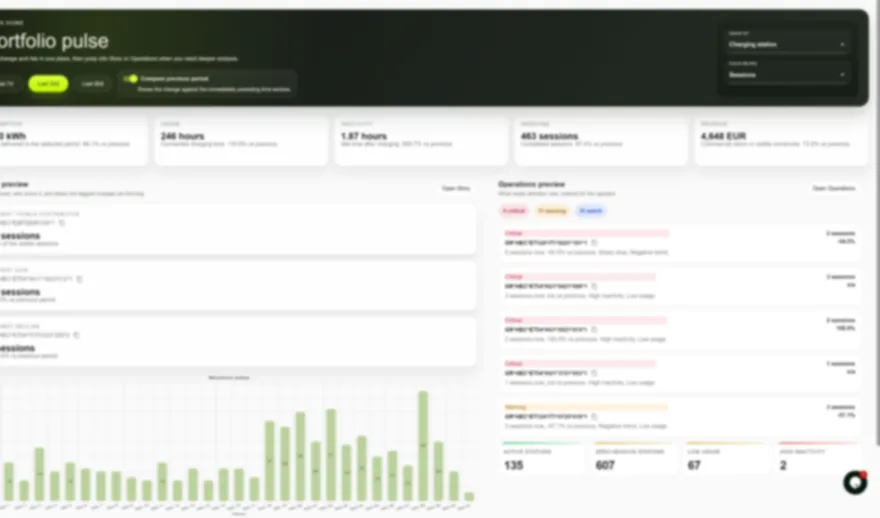
Every session, settlement, and exception in one dashboard.
What the tax office sees
A compliant fiscal receipt, signed and filed.
Tap to charge
Card · Apple Pay · Google Pay
The economics
Keep your bank. We never take your money.
You stay the merchant. Funds settle to your own acquirer, your name on the receipt — the acquirer sits behind the terminal, so we orchestrate the flow and never take a cut of your funds. A card tapped at the charger keeps card-present economics, not the online markups that quietly eat small sessions.
Settlement
Your acquirer
card-present economics · your bank rate
The four that have to be true together
Most tools get one or two right. The job needs all four.
Miss any one and the operator is back to building, locked in, or out of compliance. Hold all four and the job is actually done — it's the only combination we've found that does.
Runs on any back-office
Over OCPI, on the back-office you already run — change it, migrate it, or add a market without rebuilding payments. Any terminal, any acquirer.
Keep your own bank
You stay the merchant; funds settle to your own acquirer, your name on the receipt. The acquirer sits behind the terminal — we orchestrate, we never take a cut.
Turnkey orchestration
The payment business logic and every edge case, built — pre-auth, finalization, refunds, reconciliation. Not "you integrate it."
Fiscalization, wired to the terminal
A compliant, signed receipt at an unattended charger — the piece the standard leaves open and everyone else leaves to you.
What we run, so you don't
Four jobs. One layer.
Any terminal, any network — talking as one.
Bolt's own terminal apps sit in front of the bank you already use, and we run over any OCPI back-office. Nothing to rip out, nothing to lock you in.
The driver's tap, handled right.
Card, contactless, Apple Pay, Google Pay — no app, no account. Incremental pre-authorization, so there's no big frozen hold and no surprise on the driver's card.
Tap to charge
Card · Apple Pay · Google Pay
Every charge adds up — even the messy ones.
Half-sessions, drop-offs, partial captures, disputes — and the charge records that don't line up with the invoices — reconciled automatically, so your team never chases them.
A receipt the tax office accepts.
Country-specific fiscal receipts, with the signature wired all the way to the terminal — the piece the standard leaves open and everyone else leaves to you.

Trusted by leading operators
Live on national-scale charging networks.
Bolt runs today with national-scale networks, across multiple terminals and markets, at roughly 99.9% uptime with 24/7 monitoring — and we're an OCPI Full-Contributor, building on the open standard rather than around it.
Where the line sits
We run the money flow. We never take your customer or your bank.
Bolt is one more payment surface for you — not a layer that absorbs your business. Here's exactly what we own and what stays yours.
What we run
- The payment flow, end to end
- Multi-rail orchestration
- Reconciliation
- Fiscalization
- The edge cases nobody likes to own
What stays yours
- Your bank & acquiring
- Your CSMS
- Your terminals
- Your brand on the receipt
- Your customer relationship
Insights
What we've learned solving EV payments.
AFIR
Charging without accounts: the case for ad-hoc card payments
AFIR makes ad-hoc payment mandatory at public chargers, and tapping a card is the right default: lowest friction, every driver already carries one, and the better card-present economics.
Access
QR codes, Plug & Charge, or a card terminal?
QR moves the friction downstream, Plug & Charge needs a contract first, and only the card terminal serves every driver — an honest look at the three ways to start an ad-hoc charge.
Built for your seat
One layer. Three jobs it does for you.
Operators / CPOs
Turn on the driver's tap to recharge across your whole fleet — AFIR-ready on the chargers and terminals you already have, without becoming a payments company. Nothing built, nothing locked in.
Book a demo →Partners & integrators
A neutral layer that makes your terminals, CSMS, or app more valuable — not a competitor. Standards-based and composable.
Explore a partnership →Investors
The payments layer for a regulation-driven, multi-vendor, multi-country market — proven in production with national-scale charging networks.
Get in touch →Built to the standard
The layer the industry runs on.
We're an OCPI Full-Contributor — we help shape the standard the whole market runs on, and we keep your payments correct as it keeps moving.
Common questions
The questions operators ask first.
We already have payments in our charging platform. Why add a layer?
Those payments work only because you're on that platform. The day you migrate your back-office — and migrations happen — they break and you rebuild. Bolt runs over any back-office, so a platform change never touches your payments.
Isn't this just another charging platform with payments bolted on?
No. Bolt isn't a charging back-office and never becomes one. It sits above the terminal, the acquirer, and the back-office you already run, and orchestrates the whole money flow — the driver's tap to recharge, exact-amount capture, reconciliation, and a compliant receipt — without replacing your platform or taking your money.
Why not just let a provider be the merchant of record?
Then your bank, your rate, and your brand on the receipt all move to them — and where fiscal rules apply it breaks the receipt chain, because the seller of record has to issue the fiscal receipt. Bolt keeps you the merchant on your own bank. We orchestrate; we never take the money.
Will this lock us in?
No. Keep your bank, your back-office, and your brand. The acquirer sits behind the terminal, so we orchestrate the flow and never sit between you and your funds. Change your platform or add a market without rebuilding payments.
Do we have to change our terminals or our acquirer?
No. Bolt's terminal apps run in front of the bank you already use, over any OCPI back-office, on the terminals you already have. Nothing ripped out, nothing locked in.
Is this actually live, or a roadmap?
Live in production today with national-scale networks, across multiple terminals and markets, at roughly 99.9% uptime with 24/7 monitoring. We're an OCPI Full-Contributor, building on the open standard rather than around it.
Can we be ready before the AFIR deadlines?
Yes — new integrations typically take weeks, not quarters, which leaves runway to be ready before the AFIR deadlines.
Make every charger a checkout.
Keep your bank, your brand, and your back-office. We'll run the money — the driver's tap to recharge through to a compliant receipt.